
Asking for the Gift: A Step-by-Step Guide to a Successful Major Gift Solicitation

Let me be real with you for a moment.
The ask is the moment most fundraisers simultaneously dream of and quietly dread. Your heart might be beating a little faster going in. You're running through every possible response in your head. And underneath it all, there's a small voice whispering: What if they say no?
Here's what I want you to hold onto: a great major gift ask isn't a performance. It isn't a closing move. It's a natural, honest conversation — the culmination of a relationship you've been building with care and intention.
When you walk in grounded in that truth, everything changes.
Before You Walk In: Preparation Is Everything
The quality of your ask is largely determined before you ever arrive at the meeting.
Know the donor — really know them. This is where all your discovery conversations, your notes, your genuine curiosity come together. Before the ask, revisit everything. What lights them up? What specific aspect of your mission do they talk about with the most energy? What have they said in passing that stayed with you?
That last one matters more than people realize. I'll come back to this.
Rehearse the flow, not the script. There is no magic script that works in every room. What you want is fluency — knowing your key messages so well that you can deliver them naturally, respond to what the donor is actually saying, and stay present in the conversation instead of hunting for your next line.
Practice your key messages out loud. Role-play the conversation with a colleague. Get comfortable with the shape of the meeting so it feels like a conversation, not a recital.
Shift your thinking. The single most important thing you can do before an ask is this: stop thinking "I'm asking for money" and start thinking "I'm offering an extraordinary opportunity."
You are inviting this person to do something meaningful with their resources. To make a real difference in something they already care about. To become part of a story that's bigger than any of us.
That's not pressure. That's a genuine gift. Walk in with that understanding, and quiet confidence follows.
Who Should Be in the Room
Major gift asks are rarely solo endeavors, and who joins you matters.
The major gifts officer — or the person managing the relationship — is almost always present. You know the donor best. You've built the trust. You're the one keeping the conversation grounded and human.
Bringing your executive director or CEO signals that this relationship matters at the highest level of the organization. They can speak to vision and direction in a way staff often can't — and their presence says: you matter to us.
And if you can bring a board member who is a peer of the prospect — someone they know, whose philanthropy they respect — the entire dynamic shifts. It's no longer staff asking a donor for money. It becomes one community member inviting another to join them in something meaningful.
Choose the team based on relationship and genuine connection, not rank or title.
The Meeting Itself
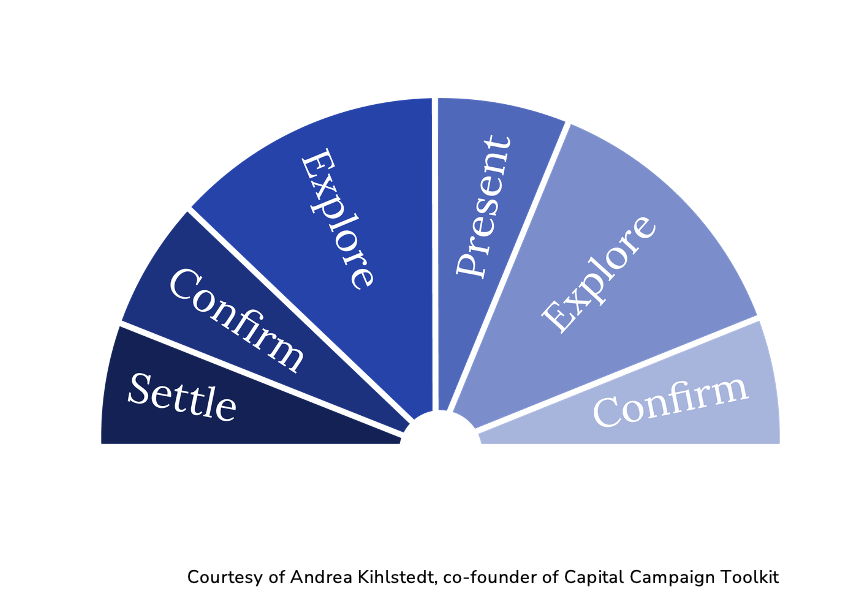 Here's the structure I coach every fundraiser to follow — six steps that move the conversation from connection to commitment:
Settle. Start by connecting as human beings. Ask about the family, the project they mentioned, the trip they just took. Let the conversation find its natural rhythm before you get to the purpose of the visit. This isn't wasted time — it's the foundation everything else rests on.
Confirm. Before moving into the substance of the meeting, confirm timing. "We planned to speak with you for about 30 minutes — is that still good for you?" It's a small gesture that respects the donor's time and signals this meeting has been thoughtfully prepared.
Explore. This is your first real conversation in the meeting — not a discovery conversation, you're well past that. It's a chance to discuss the donor's interests more deeply, hear what's on their mind, and build the natural bridge to the ask.
Here's something I believe deeply: your donor should already know that a gift conversation is coming. As the brilliant Barbara Stowe said:
"Make your donors partners of your solicitations, not victims of them."
This Explore step is where that partnership shows up. You're not ambushing anyone. You're in a real conversation with someone who knows why you're there — and is open to it.
Present. This is the Ask. Connect the donor's expressed passions to a specific, fundable opportunity. Your case should answer three questions simply and clearly: Why THIS program or project? Why YOU as the organization to make it happen? Why NOW?
Then make the ask — with a specific amount. Here's the language I coach fundraisers to use:
"Based on what you've shared with me about your passion for [their interest] — and knowing that you've been such a committed supporter at the $[previous amount] level — I'd love to invite you to consider a gift of $[ask amount]. This would allow you to [specific impact tied to their values]. How does that feel to you?"
Note that last question: "How does that feel to you?" It's not a pressure move. It's an invitation for them to respond honestly. And emotions prompt decisions. That distinction matters.
(If you're thinking about how to determine the right ask amount — whether to go higher or offer a range — read my post on the high/low ask strategy for more on that.)
Then hold the silence. I tell every fundraiser I work with: before an ask meeting, when the donor offers you coffee or water — ask for water. And then sip it.
It sounds almost too simple. But it works, because the urge to fill silence is powerful, and having something in your hand gives you something to do with the discomfort. Some donors are introverts who need to have the entire conversation in their heads before they speak. They deserve that space. Your job is to hold the room with patience and warmth while they think. This isn't a negotiation. It's respect.
Explore (again). Now that the donor has heard what you've shared, they may have questions, pushback, or things they want to think through. Welcome this. Don't be afraid of it.
An objection is almost never a refusal. It's almost always a request for more information or more time. When a donor says "That's a significant amount" or "I need to talk it over with my wife" — take a breath and get curious.
"I completely understand. Tell me more about what you're thinking."
"That makes total sense. What aspects of this would be most helpful for you two to discuss?"
Listen more. Explain less. Let them lead you to what they actually need. Questions after the ask aren't a warning sign — they're engagement. They're the donor working their way toward a yes.
And if the answer is genuinely no? Be gracious. Stay warm. The relationship is the most important thing in the room — always — and a no today is not a no forever. Exit with the relationship fully intact and the door wide open.
Confirm. Whether they say yes in the room or ask for time to think, confirm the next step before you leave.
If they've agreed to the gift: "This is wonderful. I'll follow up in the next day or two to confirm everything in writing."
If they want more time: "Of course — that makes total sense. Shall I follow up in about 10 days, or would a couple of weeks feel more comfortable?"
Either way, you leave with a clear next step and the relationship intact. Within 24 hours, send a personal note from everyone who was in the room. Then a formal letter confirming the details of the gift or pledge.
That swift, warm follow-through is where stewardship begins. It tells the donor: the relationship didn't end when you said yes. It deepened.
If They Have Questions — or Say "Not Yet"
An objection is almost never a refusal. It's almost always a request for more information or more time.
When a donor says "That's a significant amount" or "I need to talk it over with my husband" — take a breath and get curious.
"I completely understand. Tell me more about what you're thinking."
"That makes total sense. What aspects of the proposal would be most helpful for you two to discuss?"
Listen more. Explain less. Let them lead you to what they actually need.
And if the answer is genuinely no? Be gracious. Stay warm. The relationship is the most important thing in the room — always — and a no today is not a no forever. Express genuine appreciation for their consideration, and for everything they already bring to the organization. Exit with the relationship fully intact, and the door wide open.
After the Yes
First: let yourself feel it. This is a genuinely joyful moment. Share in it with the donor.
Then, gently clarify the details: the timing, the payment structure, whether they'd prefer a pledge, what fund it should support.
Within 24 hours, follow up personally — a note or call from everyone who was in the room. Then a formal letter confirming the pledge details and its purpose.
That swift, warm follow-through is where stewardship begins. It tells the donor: the relationship didn't end when you said yes. It deepened.
What This Looks Like in Practice
I want to share a story from an executive director I'm currently coaching.
She had a couple who had been giving $20,000 a year from their family foundation — loyal, committed, wonderful partners. In reviewing her notes before our strategy session, she recalled a small detail from a casual conversation: they had mentioned hearing that the organization was having some trouble with the air conditioning at their community hub.
That detail became the key to everything.
When we talked through the situation together, we discovered that the local utility was already planning to replace the air conditioning at no cost to the organization. The practical problem the couple had wanted to help with? Already solved.
But what they had signalled — a genuine desire to support the organization, a responsiveness to its practical needs, a real care for the people who used that space — was still very much alive.
We identified that this couple might be the perfect match gift donors for the organization's upcoming Big Giving Day. The ED decided to ask them for $40,000 — double their usual annual gift — to serve as a matching challenge that would inspire the broader community to give.
She was a little nervous. She wasn't sure they'd say yes to that number.
They said yes.
She had hoped to raise $70,000 on Big Giving Day. With the match gift inspiring the community, she raised $100,000.
That didn't happen because of a clever strategy or a rehearsed closing line. It happened because she knew her donors, she listened to what they had told her, and she offered them something genuinely meaningful — a way to multiply their generosity and light up an entire community.
That is what a great ask looks like. And it starts long before you sit down across from the donor.
One More Thing
If you're still nervous going into your next ask, I want to leave you with this:
The confidence you're looking for isn't the absence of nerves. It's the presence of preparation, clarity, and genuine belief in what you're offering.
You've done the work. You know this donor. You believe in this mission. You are inviting someone you respect to be part of something larger than either of you.
Walk in with that. It is more than enough.
Q: What's the best language to use when asking a major donor for a gift?
The ask language I coach fundraisers to use sounds something like this:
"Based on what you've shared with me about your passion for [their interest] — and knowing that you've been such a committed supporter at the $[previous amount] level — I'd love to invite you to consider a gift of $[ask amount]. This would allow you to [specific impact tied to their values]. How does that feel to you?"
The key word throughout is invite. You're not closing a deal. You're offering a genuine opportunity to someone you've built a real relationship with.
Make it your own — you know this donor, so the language should reflect your relationship and the specific conversation you've been having. The structure stays the same: acknowledge their history, name the amount, connect it to their values, and end with an open question that invites their honest response.
Q: What do I do about the silence after I make the major gift ask?
Hold it. Don't break it. Don't add qualifiers or soften what you just said.
Here's a practical tip I give to every fundraiser I work with: before an ask meeting, when the donor offers you something to drink, ask for water. Then sip it in those quiet seconds after the ask. It gives you something to do with the physical discomfort of silence — and keeps you from saying something you'll regret.
The silence after an ask isn't awkward. It's necessary. Some donors are introverts who process deeply before they speak. Some are weighing everything in real time. What looks like hesitation is often thoughtful consideration.
Your job is to hold that space with patience and quiet confidence. Give the donor the room to think. They deserve it — and so does your ask.
—
Beth Ann Locke is the founder of The Fundraiser Coach and has been an embedded fundraiser for 30+ years and focused on major gifts for 20 years. She coaches major gift fundraisers and nonprofit leaders to build genuine donor relationships and secure transformational gifts. Learn more at thefundraisercoach.com.
