
The Event Didn’t Fail. The Plan Stopped Too Soon.
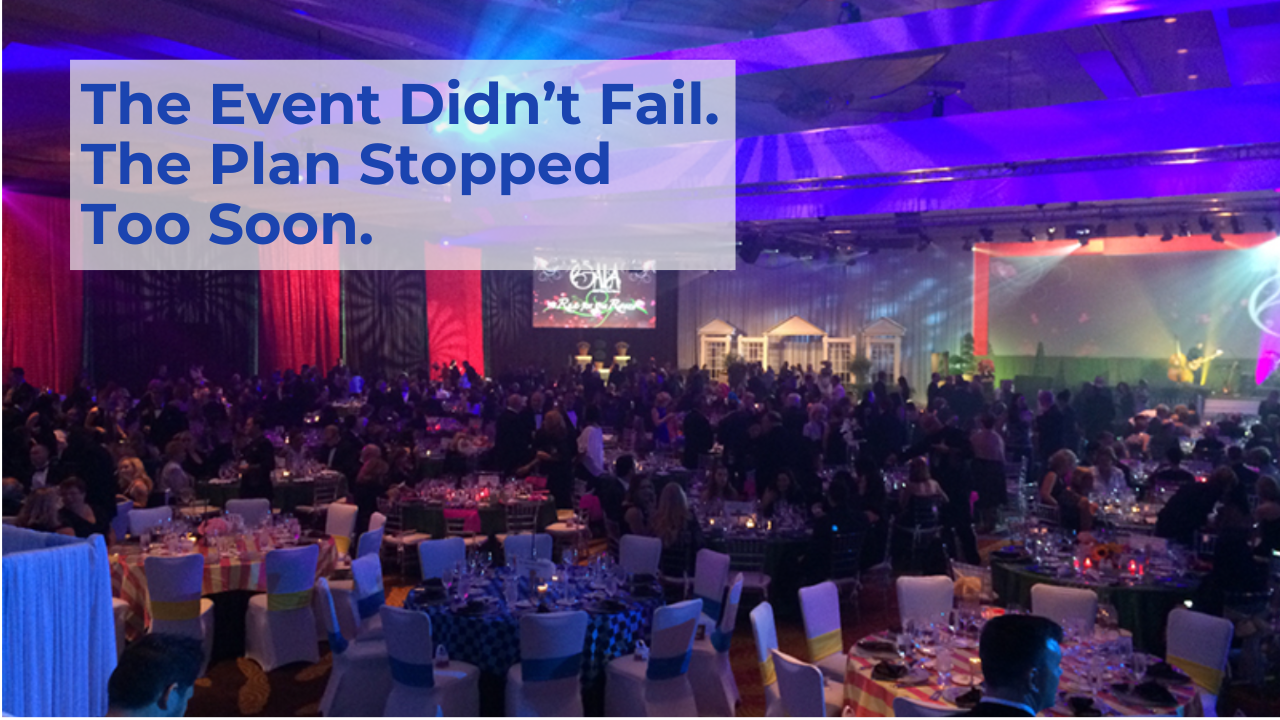
Sometimes an event does exactly what it was supposed to do.
People come. They connect. They listen. They laugh. They ask questions. They bring friends. They stay longer than expected. They tell you how moved they were. The room shifts.
And then… nothing much happens.
The thank-you emails go out. The revenue gets reconciled. The board gets a report. The staff takes a deep breath and moves on to the next deadline.
Somewhere in that transition, the relationship opportunity quietly disappears.
This is why I often say: "The event didn't fail. The plan stopped too soon."
Most organizations are very good at planning the event itself. Timelines, task lists, vendor deadlines, sponsor packages, run-of-show documents, seating charts, invitation lists, scripts, post-event revenue reports.
What far fewer organizations have is a relationship plan. And for major gift fundraising, that is the plan that matters most.
A relationship plan changes what you notice
A relationship plan asks a different set of questions before the event begins.
Who are we hoping to move closer? What do we want to learn? Who is watching for donor signals? Who will follow up, and what will they say? What invitation might come next? How will we know whether the event deepened trust?
This does not have to be complicated. It works best when it is simple enough to actually use. But it needs to exist before the event happens.
Because once the event is over, everyone is tired. Tired fundraisers don't build thoughtful follow-up strategy from scratch. They send the standard thank-you. They close the event file. They move on.
That is how donors who leaned in become donors who slip away.
Notice the signals before they disappear
Before the event, identify a short list of priority guests. Not necessarily the wealthiest people in the room, but the people whose relationship matters, whose interest is growing, or whose next step needs attention.
Ask leadership and staff to notice specific things ahead of the event:
Who brought someone new/ or had a table of new guests?
Who are sponsors bringing to the table?
Who purchased higher priced/ VIP tickets?
Who, among our guests, are people we should be connecting with to move the relationship along?
During the event, nonprofit leadership and major gift fundraisers should notice and note the following:
Who asked a question about impact?
Who wanted to meet the CEO or program leader?
Who seemed moved by a story?
Who stayed after or later?
Who talked about their own connection to the mission?
Then immediately after the event, debrief through a relationship lens. Not just "How much did we raise?" but "Who attended? Who leaned in? What did they respond to? What did we learn? What should happen next?"
Those questions can change everything.
The major gift opportunity is often quiet. It may be in the donor who lingered to ask one more question. The sponsor who brought a friend and introduced them to your board chair. The former donor who came back after years away. The guest who didn't give that night but was clearly listening with her whole heart.
If no one captures those moments, they disappear into the general memory of "the event went well."
But "the event went well" is not enough. For major gift fundraising, you need to know what the event made possible.
Not every event is supposed to raise money in the room
This is especially true for stewardship gatherings, tours, cultivation events, campaign briefings, and small donor receptions. Sometimes the goal is to deepen readiness. Sometimes it is to reconnect a donor. Sometimes it is to introduce a new idea. Sometimes it is to create the conditions for a future Ask.
But if the follow-up doesn't match the purpose, the opportunity weakens.
A donor who attends a campaign briefing may not need a generic thank-you. They may need:
"I was so glad you were there. When you asked about the timeline, it made me wonder if it would be helpful to talk more about where we're headed and how donors are helping move this forward."
A donor who brings a friend may need:
"Thank you for introducing Sarah to our work. I could see how engaged she was — I'd love to learn what resonated with both of you."
A donor who made a meaningful event gift may need: "
Your generosity last night created real momentum. I'd love to share what this makes possible and hear what inspired you to give."
None of that is pushy. It is attentive. And attention is what keeps the relationship alive.
The event is not complete when the room empties
The event didn't fail because not every donor immediately made a major gift. That is not how major gift relationships work.
The event is less successful than it could be only when we treat it as complete before the relationship work has happened.
So after your next event, don't just ask whether the room was full or the financial goal was met. Ask what changed.
Which relationships moved forward? Who knows more now about the work, outcomes, or mission? Who feels closer? Who is demonstrating more trust? Who seemed more curious? In addition to all of those people, who else deserves a thoughtful next step?
That is where the real fundraising begins — not when the event ends, but when the relationship plan continues.
A simple post-event debrief starts with five questions: Who attended? Who leaned in? What did they respond to? What did we learn? What is the next right touchpoint?
Start there. Because sometimes the event did exactly what it needed to do.
The plan just stopped too soon.
Q: Why don't fundraising events lead to major gifts?
Most events fall short of major gift potential not because the event failed, but because the follow-up doesn't match the relationship opportunity the event created. Events are powerful cultivation and stewardship tools — but only when there's a deliberate plan for what happens after the room empties. Without a relationship plan that continues past the event, even the most successful gatherings leave major gift momentum on the table.
Q: What should I do after a fundraising event to move donor relationships forward?
Debrief through a relationship lens — not just a revenue ledger. Ask: Who attended? Who leaned in or stayed late? What did they respond to? What did we learn? Who deserves a personal, specific next touchpoint? Then tailor your follow-up to what actually happened in the room. A donor who brought a friend needs a different response than a donor who asked about your campaign. Specific, attentive follow-up is what separates events that build major gift relationships from events that only raise event-night revenue.
You may also visit the other posts in this series:
"Do Not Let the Gala Become the Mission" and "Stop Letting Your Event Donors Stay Event Donors"
