
Don't Let the Gala Become the Mission
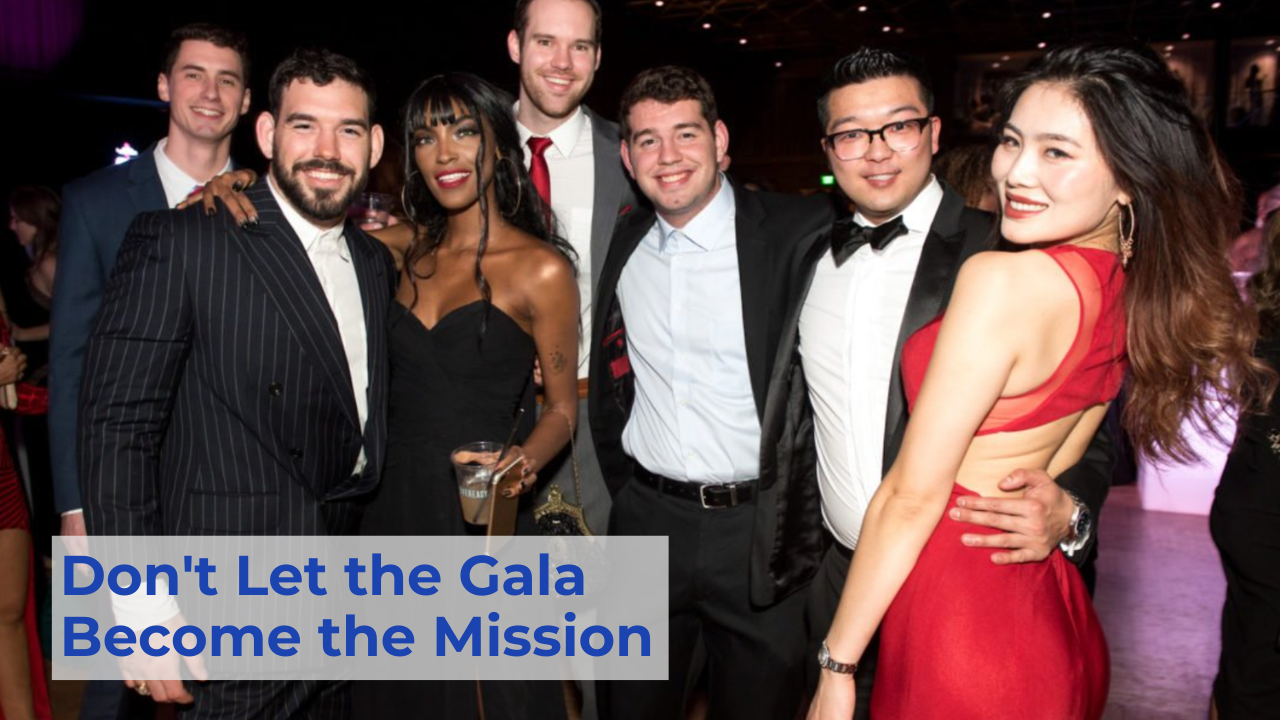
There were just three of us getting the development office going in August 1991. We were only a few months into our work when the new Executive Director of the hospital — recently arrived from Long Island — declared that we needed a gala.
And a golf tournament.
And the golf tournament should include tennis too, because not everyone plays golf.
Sounded great!
That was my introduction to the effort, organization, volunteer-wrangling, and sheer stamina events require.
Since then, I've known that there is a tipping point moment in almost every event season when the event starts to take over.
Guests need to be placed at tables using a mysterious matrix of ticket level, diplomacy, community leadership, and "please don't seat them together." Auction items need to be chased, vetted, packaged, and displayed — requiring the skills of a supply chain manager, diplomat, and part-time magician. The program script is not quite right, and did the auctioneer just drop out? Someone important hasn't RSVP'd, so calls need to be made by the co-chairs, and by the way, one of them had to make a quick trip to Buenos Aires this week. The "final" seating chart has become a living organism with opinions of its own.
And suddenly, the whole organization is fundraising for the gala.
Not for the mission. Not for the people served. Not for the transformation you are trying to make in the world.
For the gala.
I'm not anti-event. I'm anti-event-as-strategy.
Let me be clear: I am not anti-event.
Events can be joyful. They can create visibility. They can bring people together in a room where they feel the energy of the mission in a fresh way. They can introduce new people to your work. They can give long-time supporters a chance to celebrate what they have helped make possible.
But an event is not a donor relationship. It is a moment inside one.
And when we forget that, the gala starts pretending it is the strategy.
That is when things get wobbly.
We start measuring success only by the number of people in the room, the sponsorship total, the paddle raise, or the gross revenue from the night. (Ahem — I mean the net revenue.)
Those numbers matter. But they are not the whole picture.
The deeper question is: What did this event make possible next?
Did a donor hear something that moved them? Did a sponsor show signs of deeper alignment? Did someone bring a friend who was clearly engaged? Did a long-time guest ask a more thoughtful question than usual? Did a board member make an introduction that deserves follow-up? Did someone lean in emotionally when a certain story was shared?
Those are not little details. Those are donor clues. And major gift fundraising depends on our ability to notice them.
After the party
Too often, the event ends and everyone collapses. Understandably.
Events are exhausting — physically, mentally, and emotionally. Staff members are tired. The board is relieved. The development team is already reconciling numbers, sending thank-you notes, and catching up on everything that got pushed aside while the event consumed the calendar.
But this is exactly where major gift opportunity can be lost.
Because the most important question after an event is not only, "How much did we raise?"
It is: Who moved closer?
Who moved closer to the mission?
Who moved closer to a conversation?
Who moved closer to trust?
Who moved closer to a more meaningful invitation?
If all your energy goes into getting people into the room, but very little goes into what happens before and after the room, you are leaving major gifts on the table.
The event may have been beautiful. The program may have gone perfectly and everyone may have applauded at all the right moments.
But if no one follows up in a thoughtful, personal way with the donors who showed deeper interest, the event has done only part of its job.
This is especially important for major gift fundraisers and nonprofit leaders. Your best event strategy is not just logistics. It is relationship movement.
Before, during, and after — a different set of questions
Before the event, ask:
- Which donors need personal attention before they arrive?
- Who should be invited by a board member, CEO, or program leader?
- Who needs context so they understand why this gathering matters?
- Who are we hoping to move into a deeper conversation?
During the event, ask:
- Who is leaning in?
- Who is asking thoughtful questions?
- Who brought someone new?
- Who seems emotionally connected to a particular part of the mission?
- Who is showing us they care more deeply than we realized?
After the event, ask:
- Who needs a thank-you call or a personal note? (In many cases, I'd suggest everyone — and make it personal.)
- Who should be invited for coffee, a tour, or a follow-up conversation?
- Who needs to hear more about the impact behind that evening?
- Who is ready for a next step?
That is where the major gift strategy begins to emerge.
Not in the centerpieces or the auction packages. Not in whether the room looked full or the "right" people seemed to be there. Rather, it is in what the event helped reveal about the people who care about your mission.
Your mission is the mission
The gala is not the mission. The luncheon is not the mission. The golf tournament, garden party, anniversary celebration, open house, donor reception, or campaign kickoff — none of those is the mission.
The event is simply one doorway.
And when we treat it that way, we stop asking the event to do a job it was never meant to do alone. We stop letting the gala become the whole fundraising strategy.
We start using events for what they can do beautifully: create moments of connection that can be nurtured into deeper trust, stronger relationships, and more meaningful gifts.
Four days before your next event, gather your Executive Director, Director of Development, and fundraising team to review the guest list through a relationship lens. Your leadership may have 150 conversations that evening — but a handful of those need to be intentional, not haphazard. Identify five to ten guests who deserve a thoughtful conversation, a meaningful introduction, or a clear next step.
Which five guests need that kind of attention?
Those questions can shift your event from a single fundraising moment into the beginning of a more intentional major gift strategy.
Q: Why shouldn't a gala be my nonprofit's major gift strategy?
Because events create moments — and major gifts come from relationships. A gala can be a powerful doorway into deeper donor connection, but only if there's a deliberate plan for what happens before and after the room. When the event becomes the strategy, the focus shifts to logistics, revenue, and room count instead of the donor relationships that actually produce transformational gifts. The event's job is to open doors. The relationship strategy is what walks through them.
Q: How do I use fundraising events to build major gift relationships?
Start by asking different questions — before, during, and after the event. Before: who needs personal attention or context before they arrive? During: who is leaning in, asking questions, or showing emotional connection to the mission? After: who moved closer to a conversation, and what is the right next step? Major gift opportunity lives in those moments. The donors who linger, who bring friends, who ask thoughtful questions — they are showing you something. The organizations that notice and follow up are the ones that turn events into major gift momentum.
—
Beth Ann Locke is the founder of The Fundraiser Coach and has been an embedded fundraiser for 30+ years and focused on major gifts for 20 years. She coaches major gift fundraisers and nonprofit leaders to build genuine donor relationships and secure transformational gifts. Learn more at thefundraisercoach.com.
