Back to Blog

An Event Tactic That Raised More Money - Pledge Card
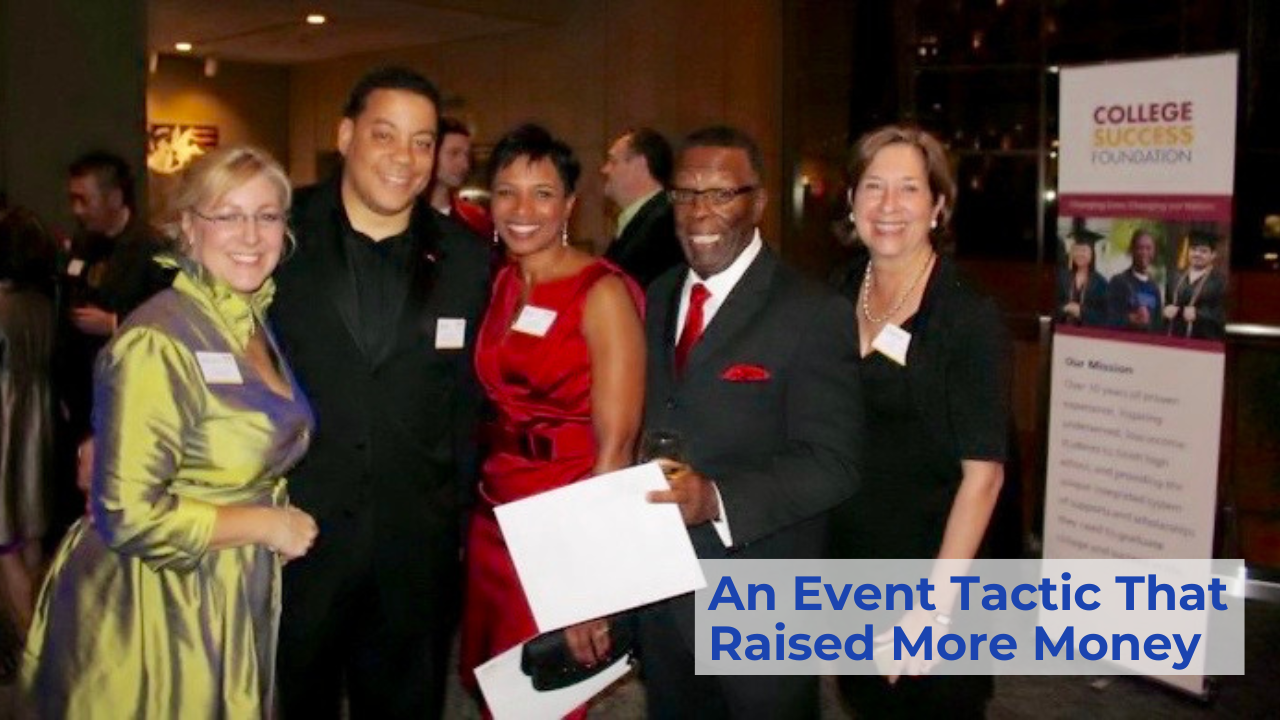
Years ago, when I was working at the College Success Foundation, one of our founders brought a new idea to the team for our big fundraising evening. 

She had attended another event where each guest had a place card at their seat. On the outside, it looked like a normal place card.

But inside? A pledge card.

We all had the same reaction: Brilliant.

And because our event was relatively small - about 180 seated guests - we knew we could implement it without creating a logistical monster.

The finished piece looked simple: a folded place card at each seat, personalized for the guest. But inside, we merged the information we already had in Raiser’s Edge: name, preferred address, preferred phone number, and preferred email.

It was part place card, part pledge card. Part donor information update. Part quiet invitation to give.

And it worked beautifully.


Not every donor wants to raise a paddle

That night, we had several ways for people to give.

We had a six-item auction. We also had 17 table centrepieces - hand-blown glass pieces - available for purchase. And we had a traditional Raise the Paddle.

Altogether, the event raised about $415,000 from 169 guests - not including the students seated at each table - with expenses of approximately $60,000.

That is a strong evening.

But one of the most interesting results came from the place card pledge cards. We received 79 donations through those cards, with an average gift of $2,789.

Even more interesting: 18 of those gifts came solely from the place card pledge card, with an average gift of $322.

Those were gifts we may not have received otherwise.

They represented people who wanted to give, but perhaps not through the public Raise the Paddle moment. Some were able to give at a lower level than the paddle amounts being called. Some may not have wanted the visibility of raising their hand in the room. Some may simply have appreciated a quieter, easier way to participate.

That matters.

Because not every donor wants to give in the same way. Some donors love the energy of a paddle raise. They enjoy the momentum, the public participation, the feeling of being part of something larger. Others care deeply, but prefer privacy.

A thoughtful event strategy makes room for both.

A quiet giving option can be a generous invitation

One of the mistakes organizations make at events is assuming that the public giving moment is the only giving moment. It is not.

A paddle raise can be powerful. So can a private pledge card. The place card method gave guests a way to give without stepping into the spotlight.

That was especially helpful because our audience included people who might not have been in our usual prospect pool. Some were university administrators, presidents, educators, or community members who cared about the mission but were not necessarily being cultivated as major gift prospects.

The place card gave them a doorway. A simple one.

No pressure.
No spectacle.
No waiting for the right paddle level.

Just an invitation sitting in front of them.

And because it was personalized, it felt more intentional than a generic pledge card dropped on the table.

It also helped clean up the database

This was the second win.

Because we merged the cards from Raiser’s Edge just two days before the event, the information was fresh from the CRM. Guests could review their name, preferred address, phone number, and email.

And 17 people corrected or updated their contact information.

That may not sound glamorous, but every fundraiser knows how valuable that is. Correct donor information is not just administrative housekeeping. It is part of relationship care.

If we want to communicate with donors personally, thank them well, invite them thoughtfully, and follow up in meaningful ways, we need good information.

A donor’s home address matters.
A preferred email matters.
The correct spelling of a name matters.
Knowing how someone wants to be reached matters.

Good data helps us be more personal. And in fundraising, personal matters.

It made the end of the evening easier

There was a third benefit, too.

Many guests were able to include credit card information directly on the pledge card and turn it in during the evening. That meant fewer people waiting in a checkout line at the end of the event.

No long bottleneck. No awkward delay searching for auction items,No crowd of guests waiting to pay while staff tried to reconcile everything. By the end of the evening, the only real waiting was for boxing up the centrepieces.

Anyone who has worked an event knows: that is a win.

The guest experience matters. If giving feels easy, thoughtful, and well-organized, people remember that.

This works best when the event Is the right aize

The previous year, our event had been a much larger 10th anniversary celebration with about 800 guests. Could we have used this same tactic there? Possibly.

But it would have required much more lead time, more staffing, more printing coordination, more data checking, and more careful execution.

For an event of 180 people, it was manageable.

For a larger event, you might use the tactic only with a high-touch group: major donors, board-hosted tables, special guests, sponsors, or a leadership circle.

The point is not that every event needs this exact tactic.

The point is that every event should ask:

Are we making it easy for people to respond generously in the way that feels right for them?

Because sometimes the event design itself creates or limits generosity.

Small event details can create big relationship wins

What I love about this example is that it was not flashy.

It was not a new gala theme.
It was not a complicated sponsorship package.
It was not a dramatic stage moment.

It was a simple, thoughtful tool that served the donor and the organization.

It helped people give.
It helped us update donor information.
It made checkout easier.
It gave quieter donors a way to participate.
It created a more personal experience at the table.

That is good fundraising design. And it is a reminder that events do not have to rely only on the big moments. Sometimes the most effective fundraising tools are the ones that quietly remove friction. A place card can do more than show someone where to sit.

It can say:

We know you.
We’re glad you’re here.
Here is a simple way to participate.
And we want to stay connected with you afterward.

That is a small detail.

But small details can deepen trust.

And trust is where generosity grows.

A question for your next event: Where could you make giving easier, more personal, or more comfortable for the donors in the room?

Because not every donor wants to raise a paddle.

But many donors want to be invited.


The ”silent/via place card” gifts helped us in two ways: 1) to encourage giving and/or additional gifts and 2) to obtain new or corrected address information on our guests.

A total of 79 donations were received that night from these place cards/pledge cards with an average gift $2,789. That was 18 additional gifts solely from the place card/ pledge card, with an average gift of $322 (23% of people giving and 3% of gifts). We received three $1,000 gifts, two $500 gifts and then the rest were below the amount for Raise the Paddle. Many of these supporters were people who might be university administrators or presidents (part of our audience) but may not have been considered in our usual prospect pool.

Second, we also had 17 people amend their contact information - so we are able to be more donor-centric. Since these cards were produced and merged two days before the event, it was "fresh off the database." It helped capture some information that we should have had, and others for new supporters, gave us what we needed to know (e.g., home address).

[caption id="attachment_1980" align="alignright" width="698"] My colleagues and I celebrating the College Success Foundation 10th Anniversary gala.[/caption]

Third, we were also able to secure many credit card payments via this method, as people were able to add their credit card information and turn in the card, rather than wait in a “check out” line. This meant that there was literally no waiting at the end of the evening, except for boxing the centerpieces.

The previous year's event had been a more lavish extravaganza celebrating the 10th anniversary and we welcomed 800 guests. It would have needed much longer lead time to prepare this for an event that size, but for an event this size (or smaller) I think it is a terrific way to capture some donors who don’t want to be part of the “splash” of raising their paddle when gift levels are called, or who are able at that moment to give a gift, but at a lower gift size.

For the entire event, from 169 guests (excluding the students, we had one scholar at each table for tables of 11) we raised $415,000. Not bad for one night! The expenses were approximately $60,000.

What innovations have you discovered for your events that help provide better connection or opportunities to give? I would love to hear!


Previously published July 18, 2011

/ /