
One by One: A Simple Way to Engage Your Board in Donor Thanking
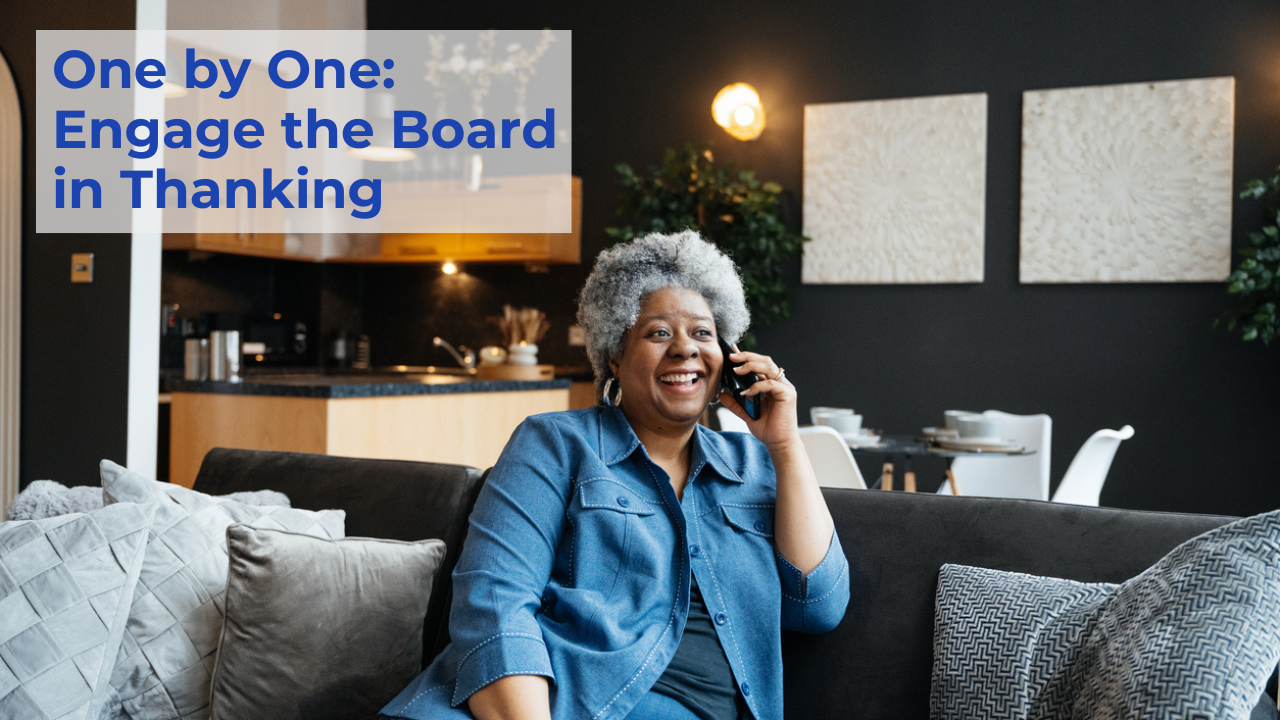
In my earlier post, I shared how engaging board members in Thank-a-Thons can energize both your donors and your board.
But not every organization wants — or needs — to gather everyone in a room (or on Zoom) to make calls.
There’s another approach that is just as powerful — quieter, more consistent, and, in many ways, more sustainable.
One-by-one board thank-you calls.
Why this matters
If Thank-a-Thons create energy, this approach creates rhythm. It builds donor relationships steadily over time.
It gives board members a clear, manageable way to engage. And it ensures that thanking becomes part of your organization’s culture — not just an occasional event.
Because gratitude isn’t something we do once. It’s something we practice.
What makes this approach so effective
There’s a reason I keep coming back to this.
When donors receive a personal thank-you call — especially from a board member — it changes how they experience your organization.
- They feel noticed.
- They feel appreciated.
- They feel connected.
And when that call comes quickly after the gift? The impact is even stronger.
This idea isn’t new. Penelope Burk’s research — outlined in Donor-Centered Fundraising — showed that when board members called first-time donors within 24 to 48 hours, future giving increased by 39% and second gifts by 43%. More recent research by Bloomerang shows a similar pattern: donors who receive a phone call are significantly more likely to give again—and sooner.
But beyond the data, I’ve seen this play out again and again: A short call. A genuine thank you. A moment of connection. And the relationship shifts.
How this works in practice
Instead of gathering everyone at once, you create a simple, repeatable system.
When a gift comes in, a board member is assigned one or two calls to make. That’s it. No overwhelm. No complicated logistics. Just a steady flow of gratitude.
This works particularly well for:
- New donors
- Upgraded donors
- Long-time loyal supporters
- Monthly donors at meaningful levels
In other words, the relationships you most want to strengthen.The only caveat: the board member has to be willing. Without that, the calls simply don’t happen.
What you need to have in place
This approach works beautifully — but only if the system behind it is clear.
1. A timely process
As noted in the data above, speed matters. If possible, aim to have calls made within 24 – 48 hours of the gift being received.
That may mean adjusting how you capture and share donor information internally. If your acknowledgment letters take a week (or more), that’s okay. But the call should come first. (This is separate from the automatic thank-you that comes with online gifts.)
2. A clear point of coordination
Someone on your team needs to own this process.
They should be able to:
- Pull donor information quickly
- Assign calls to board members
- Share relevant context
- Track what happens afterward
The simpler the system, the more sustainable it will be.
3. Board buy-in (especially from your chair)
As with most board engagement strategies, this works best when leadership is aligned. Your board chair should be one of the first to participate. Their involvement signals that this matters.
And it makes it much easier to bring others along.
4. Manageable expectations
Don’t overwhelm your board. I usually suggest assigning one to three calls at a time.
That keeps it realistic — and increases the likelihood that the calls actually happen.
5. Thoughtful donor selection
Be intentional about who receives these calls. This is not just about the largest gifts.
Think about:
- Who is new
- Who is increasing their giving
- Who has been loyal over time
- Who you want to know better
This is about building relationships — not just recognizing revenue.
What to give your board members
Clarity builds confidence.
Provide:
- Donor name(s) and how they’re addressed
- Phone number (and note if it’s a mobile, office or home line)
- A brief note on why the gift matters (if known, and don't offer the exact amount)
- A simple script
You don’t need to over-prepare them. You just need to help them feel ready.
A simple script
Something like:
“Hello, this is [Name], and I’m a board member with [Organization].
I’m calling to personally thank you for your recent gift. It truly makes a difference.”
Pause.
Let the donor respond.
And if the conversation opens up:
“Would you be open to sharing what inspired your gift?”
That one question often leads to insight your team wouldn’t otherwise have.
A note on voicemail
If the donor doesn’t answer, encourage board members to leave a message. Short. Warm. Clear. And no pressure for a call back.
The goal is gratitude — not a conversation at all costs.
What happens after the call
This is where many organizations lose the value. You need to capture what was learned.
Encourage board members to share:
- Whether they connected or left a message
- Anything the donor shared
- Any updates to contact information
- Any follow-up needed
Even a few notes can significantly strengthen your understanding of that donor.
A small but important insight
Early on, I thought it might be best to match board members with donors they already knew. In practice, I found the opposite.
When the caller and donor don’t already have a relationship:
- The conversation stays focused
- The call is more likely to happen promptly
- The donor experiences connection to the broader organization
It may feel counterintuitive, but it works.
A modern note
Today, this can be done in a variety of ways:
- Board members making calls from their own phones
- Calls assigned via email or your CRM
- Notes captured directly into your system
- Flexible timing based on availability
The method can evolve.
The intention stays the same.
A final thought
If you want your board to feel more confident in fundraising, don’t start with asking.
Start with connection.
One call at a time.
Because when board members hear directly from donors — when they experience the gratitude, the stories, the impact — they begin to understand their role differently.
And when donors receive that call?
They don’t just feel thanked. They feel seen.
And that’s where stronger relationships — and future giving — begin.
If you prefer to gather your board and create shared energy around this work, you can also explore the Thank-a-Thon model I shared in my previous post.
Both approaches work. One builds momentum in a moment. The other builds it over time.
